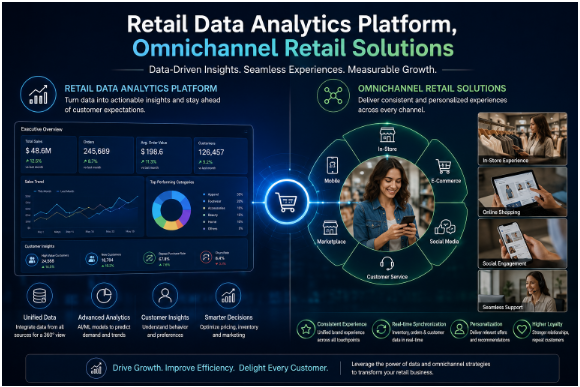
Retailers today operate across so many touchpoints — stores, apps, marketplaces, social commerce, connected TV — that without a unified view of customer and inventory data, omnichannel retail solutions quickly become a patchwork of disconnected experiences. A modern retail data analytics platform is what ties these channels together, giving retailers the real-time visibility needed to deliver a genuinely seamless shopping experience rather than a fragmented one.
The retailers pulling ahead in this environment are not necessarily the ones with the most channels. They are the ones whose channels all draw from the same trustworthy data, allowing every touchpoint to feel like part of a single, coherent brand experience — one that respects the customer’s history regardless of where the last interaction happened.
Why Fragmented Data Undermines Omnichannel Ambitions
Many retailers say they have gone omnichannel, but behind the scenes, inventory, customer, and transaction data often still live in separate silos per channel. This makes promises like buy-online-pickup-in-store, ship-from-store, and real-time stock visibility unreliable at best and false at worst.
A retail data analytics platform consolidates these fragmented sources into a single view, giving both customers and store associates accurate, real-time information regardless of which channel they are using. This is the difference between omnichannel as a marketing claim and omnichannel as an operational reality customers can actually feel.
Unifying Inventory Across Channels
Real-time inventory visibility across warehouses, stores, and online channels prevents the common failure point of a customer ordering something the store does not actually have. It also unlocks smarter fulfillment decisions that reduce shipping cost and delivery times.
Connecting Customer Data for True Personalization
When purchase history from in-store, app, and web all feed the same analytics platform, personalization engines can recommend relevant products regardless of where the customer last shopped. This is what real omnichannel retail solutions look like from the customer’s side.
Turning Data Into Real-Time Omnichannel Decisions
The real value of a retail data analytics platform is not just historical reporting — it is enabling real-time decisions. Dynamic pricing, localized promotions, demand-based replenishment, and personalized offers all depend on analytics that update continuously rather than in nightly batches.
This immediacy is what makes omnichannel retail solutions feel seamless to the customer: a promotion seen online reflects in-store, stock shown as available is genuinely available, and personalized recommendations reflect the most recent interactions, not last week’s data.
- Real-time inventory sync across all fulfillment channels
- Unified customer profiles powering consistent personalization everywhere
- Demand forecasting models that adjust for local and seasonal trends
- Dashboards giving store and e-commerce teams shared visibility into performance
- Dynamic pricing engines that respond to real-time market signals
- Predictive stock allocation optimizing where each SKU should sit across the network
Preparing Retail for the Next Wave of Change
Retail keeps evolving. Live shopping, generative AI shopping assistants, and increasingly sophisticated marketplace algorithms all place new demands on the underlying data platform. A retail data analytics platform designed only for last year’s channel mix will struggle to keep up with next year’s.
Forward-looking retailers are building analytics foundations that anticipate this change — event streaming architectures that can absorb new channels quickly, unified customer profiles that extend naturally to new digital touchpoints, and machine-learning pipelines that improve with every transaction. This future-ready approach is what makes omnichannel retail solutions sustainable rather than a snapshot that ages badly.
Building Toward a Truly Connected Retail Experience
Retailers that invest in a strong analytics foundation find that omnichannel initiatives — from curbside pickup to endless-aisle in-store kiosks — become far easier to execute reliably, because the underlying data supporting them is already accurate and current.
The retailers winning today are not necessarily the ones with the most channels, but the ones whose channels all work from the same trustworthy data platform. That foundation is what turns digital retail ambition into operational reality.
Common Pitfalls in Retail Omnichannel Programs
Retail omnichannel programs share a recognizable set of failure modes. Being explicit about these pitfalls helps retail leaders design initiatives that avoid the most costly mistakes.
- Rolling out new channels before the retail data analytics platform is unified across existing ones
- Treating omnichannel retail solutions as a marketing project rather than an operational transformation
- Underinvesting in in-store technology so associates have less information than customers browsing online
- Ignoring return rate signals as an early warning that channel experiences are inconsistent
- Failing to build change management for merchandising and store teams around new analytics workflows
- Assuming batch analytics is enough when real-time decisions increasingly drive customer experience
Best Practices That Separate Leading Omnichannel Retailers
The retailers pulling ahead in omnichannel share a set of operational disciplines that show up regardless of geography, category, or scale. These practices consistently correlate with stronger conversion and higher customer lifetime value.
- Treat inventory accuracy as a leading indicator of digital customer satisfaction
- Empower store associates with the same real-time customer profile the digital channels use
- Measure omnichannel success by cross-channel repeat purchase behavior, not siloed channel revenue
- Invest in fulfillment orchestration so each order is routed through the most cost-effective path automatically
Actionable Insights for Enterprise Leaders
- Consolidate inventory data across all channels into a single retail data analytics platform before expanding omnichannel offerings
- Use real-time customer data to power personalization consistently across web, app, and in-store touchpoints
- Invest in demand forecasting models that account for local, seasonal, and event-driven variation
- Give store associates the same real-time visibility that customers see online
- Design the analytics platform to accommodate new channels rather than optimizing only for today’s mix
- Measure omnichannel retail solutions success by customer LTV and cross-channel repeat purchase rate, not just per-channel revenue
Conclusion
Omnichannel retail solutions are only as strong as the retail data analytics platform behind them. Retailers that build a robust analytics foundation create the real-time visibility needed to deliver consistent, trustworthy experiences across every channel — turning omnichannel from a marketing promise into an operational reality customers can actually feel.