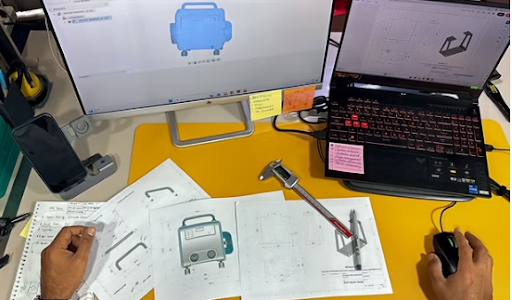
A product rarely moves from a brilliant idea to a production-ready solution in a straight line. A promising concept can lose weeks to an overlooked tolerance, an impractical component, a difficult manufacturing process, or a prototype that exposes problems too late. The real challenge is not simply designing faster, but making better decisions earlier in the development cycle.
An engineering service design studio brings design thinking and engineering expertise together to test feasibility, resolve technical challenges, and refine concepts before costly commitments are made. This integrated approach can turn product development from a cycle of repeated corrections into a more predictable journey from concept to market.
1. Defining the Product Before Designing It
Many development problems begin with an unclear brief. A business may know what it wants to create but not have clearly defined performance requirements, user needs, dimensions, materials, or operating conditions. An engineering design team helps translate the initial concept into practical specifications.
This may involve understanding:
- Who will use the product.
- What problem it needs to solve.
- Where and how it will operate.
- Required performance and durability.
- Size and weight limitations.
- Manufacturing expectations.
- Applicable technical requirements.
2. Identifying Engineering Problems Early
Late-stage engineering changes are expensive because they can affect completed CAD models, prototypes, tooling, and production schedules. Early engineering reviews can identify potential problems with structural integrity, component interfaces, mechanisms, tolerances, material selection, and assembly.
For example, a housing may appear suitable visually but leave insufficient space for internal components or make maintenance difficult. Finding such an issue during the concept or CAD stage is considerably easier than discovering it after manufacturing has begun. Early engineering therefore acts as a risk filter, helping teams eliminate impractical ideas before they consume significant resources.
3. Designing With Manufacturing in Mind
A product that can be modelled successfully cannot necessarily be manufactured efficiently. Design for Manufacturing (DFM) considers how the final product will actually be produced. The selected process, material, geometry, tolerance, and assembly method all influence development decisions.
A team may assess:
Material → Manufacturing process → Component geometry → Tolerance → Assembly → Production cost
For instance, a component intended for CNC machining may require different design considerations from one intended for injection moulding. Considering these factors early helps reduce tooling changes and manufacturing complications. The objective is to create a design that is not only functional but also practical to produce at the required scale.
4. Using Prototypes to Test Assumptions
Digital models provide valuable information, but physical prototypes reveal issues that may not be obvious on a screen. Prototyping allows development teams to examine dimensions, fit, ergonomics, assembly, movement, appearance, and interaction. It also gives stakeholders something tangible to evaluate.
Rapid prototyping makes this process more efficient because early versions can be produced, tested, modified, and tested again without committing immediately to final production tooling. The important distinction is that prototypes should answer specific questions. Does the mechanism work? Is the product comfortable to hold? Do components fit correctly? Can users operate it intuitively?
Each prototype should reduce uncertainty rather than simply reproduce the final product.
5. Using CAD to Resolve Problems Before Production
Computer-aided design is central to modern product development because it allows teams to examine a product in detail before manufacturing physical components.
Three-dimensional CAD models can help identify:
- Component interference.
- Clearance problems.
- Assembly issues.
- Incorrect dimensions.
- Mechanical movement limitations.
- Enclosure constraints.
- Design inconsistencies.
Digital assemblies are particularly valuable for products containing multiple interconnected components. Engineers can assess how parts interact before committing to physical production.
6. Making Iteration a Controlled Process
Iteration is essential to product development, but uncontrolled iteration can become a source of delay.
A structured cycle creates a better approach:
Design → Prototype → Test → Analyse → Refine → Validate
Each round should have a defined purpose. One prototype may focus on ergonomics, another on mechanical performance, and another on manufacturing feasibility. This prevents teams from making multiple changes without understanding which modification actually improved the product.
Iteration also makes development more evidence-based. Instead of relying entirely on assumptions, teams can use test results, user feedback, and engineering observations to guide subsequent decisions.
7. Integrating User Needs With Engineering
A product can meet its technical specifications and still perform poorly in the real world if it is uncomfortable, confusing, or difficult to operate. User-centred design helps address this gap. Ergonomics, accessibility, interface design, handling, and operating behaviour should be considered alongside technical requirements.
For products used repeatedly, even small usability problems can have a significant effect on customer satisfaction. A poorly positioned control, uncomfortable grip, difficult maintenance process, or confusing interface may require redesign if discovered too late. Evaluating these factors during development allows teams to improve the product while changes are still manageable.
8. Bringing Different Specialists Into One Process
Product development commonly involves industrial designers, mechanical engineers, electronics specialists, manufacturers, suppliers, and business stakeholders. When these functions work in isolation, decisions can become fragmented. A designer may develop a form without knowing a manufacturing limitation, while an engineer may specify a component without considering user interaction. An integrated design process allows these perspectives to influence one another earlier.
9. Supporting the Transition From Design to Production
The development process does not end when the CAD model is approved. Manufacturing can introduce unexpected issues. Production samples may reveal fit problems, suppliers may recommend process changes, or tooling may expose weaknesses that were not apparent during prototyping.
Production support helps maintain continuity between design intent and manufacturing reality. Reviewing production files, resolving supplier feedback, checking samples, and addressing manufacturing issues can prevent small problems from becoming major schedule disruptions.
For technically demanding products, this connection is particularly important. A defense product design company in India may need to account for demanding operating environments, reliability, manufacturability, maintainability, and specific performance requirements throughout the development process.
Why Faster Development Does Not Mean Cutting Corners
The fastest development process is not necessarily the one with the fewest design stages. Removing testing or engineering reviews may appear to save time, but problems discovered later can result in expensive redesigns and production delays. Real efficiency comes from reducing avoidable rework.
An effective development process identifies constraints early, validates important assumptions through prototypes, integrates engineering with design, considers manufacturing before finalisation, and uses testing to guide each iteration. This allows teams to make informed decisions before committing substantial resources.
Conclusion
An engineering design studio can shorten product development by reducing uncertainty at every important stage. Clear requirements, early engineering input, manufacturable design, rapid prototyping, CAD validation, structured iteration, user testing, cross-functional collaboration, and production support all contribute to a smoother path from concept to finished product. The goal is not to rush through development, but to prevent avoidable delays and costly rework.
By combining creative design with engineering discipline, businesses can develop products that are functional, practical, manufacturable, and better prepared for real-world demands. Studio 701 brings this integrated approach to product development, helping turn complex ideas into viable solutions.